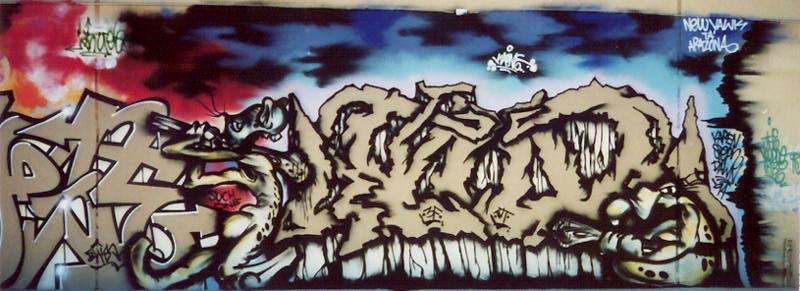
First of all, we should under stand a little bit about Graffiti. So, what are they? “They are images or letters applied without permission to publicly viewable surfaces such as walls or bridges.” (wikipedia). It has a long history, from the Ancient civilizations up to now. Nowadays, it is called “modern Graffiti” drawing with spray paints, markers or other material. 
“Acient” graffiti

Modern Graffiti
In my opinion, Graffiti is an art, not a design. At the beginning and up to now, people often call it the Graffiti Art. In the first days of the modern Graffiti, people consider it as an art. Why? Because, Graffiti did not communicate enough to be considered as design. Most of graffiti artists want to express there personal feelings and to try the feeling of thrilled when they paint on the walls, that may be consider as a crime.
Terrance Lindall, noted surrealist artist whose works for Heavy Metal Magazine and Creepy and Eerie have inspired many of these artists, goes further:
“Graffiti is revolutionary like the surrealist art I represented in my show Brave Destiny," he says, "and any revolution might be considered a crime. People who are oppressed or suppressed need an outlet, so they write on walls—it’s free... However, people also have a right to protect their property. It is a human dilemma.”
However, the boundaries between art and design are blurring. And sometimes, we can hardly define whether it is an art or a design. Some of the Graffiti works can be seen as a logo or can be found in them some meanings that they want to communicate.
I think that it has become an international style in terms of its representation. As Hip Hop is becoming more famous all over the world, the graffiti art is also becoming more common. “Modern graffiti is often seen as having become intertwined with Hip-Hop culture as one of the four main elements of the culture (along with the Master of ceremony, the disc jockey, and break dancing), through Hollywood movies such as Wild Style. However, modern (twentieth century) graffiti predates hip hop by almost a decade and has its own culture, complete with its own unique style and slang.” (wikipedia)
The graffiti art have come to Vietnam recent years and it become more and more popular among the youth. Below is a short article about this trend in Vietnam, according to the Tuoi Tre newspaper.
New passion, new playground
“The career of graffiti” of a young guy in HCM City, Minh Tri, and his friends, began with a ‘sore’ memory.
Loving painting, Minh Tri and his friends were immediately attracted by a school of art named graffiti when they watched a foreign television programme about this kind of art. They immediately sought some paint sprayers and went to the street to make graffiti works. They were apprehended by local guards for “making improper drawings on the walls”.
Seeing their son’s passion for graffiti, Tri’s parents gave him and his friend ‘a wall’ on which to make graffiti.
According to Tri, the graffiti movement has spread among Vietnamese youth. There are tens of groups of graffiti in HCM City such as B Crew, who are students at the HCM City Arts University, and 145 Crew, GraFoce, Swatcrew, and Simplecrew, who are high school students.
In Hanoi, the graffiti movement is also developing strongly with Street Jockey, Devil Day (D2), S5, B.S.P, Toy.inc, THAN and others. Other smaller cities like Da Nang and Nam Dinh have their own graffiti groups. All of these ‘graffiti artists’ learn from the Internet and from each other.
Quang Minh, a member of the Simple group, said: “I’ve never learnt how to mix colours and the skill of spraying paint, but I’ve practiced a lot so it is not difficult for me”.
According to Vietnamese graffiti makers, they faced many difficulties in the first days of this art as many people didn’t recognise it as art, but considered it a nonsensical thing. However, graffiti has been officially accepted in Vietnam as the Hanoi Friendship Culture Palace organised a graffiti festival for graffiti makers throughout Vietnam in late 2005.
Many events have been held for graffiti artists such as “The festival for the young”, “Dance 2006”, “Fantadzui”.
Not just a movement
“We don’t want others to see graffiti as a street culture. We have to join together to make a Vietnamese graffiti style,” said Nguyen Duc Thinh, team-leader of B Crew, a fifth-year student at the HCM City Arts University.
Thinh’s B Crew group has been part of many big programmes, such as a contemporary art exhibition at Van Thanh park, HCM City in April 2006 with two works, “Young” and “Live”; and a street exhibition on Nguyen Chi Thanh road, District 5, HCM City, which was also broadcast on channel 3 of the Vietnam Television (VTV).
B Crew is preparing for an international art exchange programme in Cambodia.
“We will nurture graffiti with graffiti,” said Hoang Thanh and Quang Minh of the “Simple” group. Many young people come to see Thanh and Minh to have ‘painting’ on their clothes and sandals, for which they pay VND40,000 - VND80,000/ item.
Many cafés have invited graffiti artists to decorate their cafes to make them special.
Vietnamese graffiti artists are exhorting each other on some websites like http://www.viethiphop.com/, http://www.graffiti.org/ to bring Vietnamese culture into this imported street art.
http://www.graffiti.org/mesa/ka01.jpg
http://en.wikipedia.org/wiki/Graffitihttp://www.drunkenfist.com/art/graffiti_art/digital/r_throw_up_graffiti.php
“Acient” graffiti
Modern Graffiti
In my opinion, Graffiti is an art, not a design. At the beginning and up to now, people often call it the Graffiti Art. In the first days of the modern Graffiti, people consider it as an art. Why? Because, Graffiti did not communicate enough to be considered as design. Most of graffiti artists want to express there personal feelings and to try the feeling of thrilled when they paint on the walls, that may be consider as a crime.
Terrance Lindall, noted surrealist artist whose works for Heavy Metal Magazine and Creepy and Eerie have inspired many of these artists, goes further:
“Graffiti is revolutionary like the surrealist art I represented in my show Brave Destiny," he says, "and any revolution might be considered a crime. People who are oppressed or suppressed need an outlet, so they write on walls—it’s free... However, people also have a right to protect their property. It is a human dilemma.”
However, the boundaries between art and design are blurring. And sometimes, we can hardly define whether it is an art or a design. Some of the Graffiti works can be seen as a logo or can be found in them some meanings that they want to communicate.
I think that it has become an international style in terms of its representation. As Hip Hop is becoming more famous all over the world, the graffiti art is also becoming more common. “Modern graffiti is often seen as having become intertwined with Hip-Hop culture as one of the four main elements of the culture (along with the Master of ceremony, the disc jockey, and break dancing), through Hollywood movies such as Wild Style. However, modern (twentieth century) graffiti predates hip hop by almost a decade and has its own culture, complete with its own unique style and slang.” (wikipedia)
The graffiti art have come to Vietnam recent years and it become more and more popular among the youth. Below is a short article about this trend in Vietnam, according to the Tuoi Tre newspaper.
New passion, new playground
“The career of graffiti” of a young guy in HCM City, Minh Tri, and his friends, began with a ‘sore’ memory.
Loving painting, Minh Tri and his friends were immediately attracted by a school of art named graffiti when they watched a foreign television programme about this kind of art. They immediately sought some paint sprayers and went to the street to make graffiti works. They were apprehended by local guards for “making improper drawings on the walls”.
Seeing their son’s passion for graffiti, Tri’s parents gave him and his friend ‘a wall’ on which to make graffiti.
According to Tri, the graffiti movement has spread among Vietnamese youth. There are tens of groups of graffiti in HCM City such as B Crew, who are students at the HCM City Arts University, and 145 Crew, GraFoce, Swatcrew, and Simplecrew, who are high school students.
In Hanoi, the graffiti movement is also developing strongly with Street Jockey, Devil Day (D2), S5, B.S.P, Toy.inc, THAN and others. Other smaller cities like Da Nang and Nam Dinh have their own graffiti groups. All of these ‘graffiti artists’ learn from the Internet and from each other.
Quang Minh, a member of the Simple group, said: “I’ve never learnt how to mix colours and the skill of spraying paint, but I’ve practiced a lot so it is not difficult for me”.
According to Vietnamese graffiti makers, they faced many difficulties in the first days of this art as many people didn’t recognise it as art, but considered it a nonsensical thing. However, graffiti has been officially accepted in Vietnam as the Hanoi Friendship Culture Palace organised a graffiti festival for graffiti makers throughout Vietnam in late 2005.
Many events have been held for graffiti artists such as “The festival for the young”, “Dance 2006”, “Fantadzui”.
Not just a movement
“We don’t want others to see graffiti as a street culture. We have to join together to make a Vietnamese graffiti style,” said Nguyen Duc Thinh, team-leader of B Crew, a fifth-year student at the HCM City Arts University.
Thinh’s B Crew group has been part of many big programmes, such as a contemporary art exhibition at Van Thanh park, HCM City in April 2006 with two works, “Young” and “Live”; and a street exhibition on Nguyen Chi Thanh road, District 5, HCM City, which was also broadcast on channel 3 of the Vietnam Television (VTV).
B Crew is preparing for an international art exchange programme in Cambodia.
“We will nurture graffiti with graffiti,” said Hoang Thanh and Quang Minh of the “Simple” group. Many young people come to see Thanh and Minh to have ‘painting’ on their clothes and sandals, for which they pay VND40,000 - VND80,000/ item.
Many cafés have invited graffiti artists to decorate their cafes to make them special.
Vietnamese graffiti artists are exhorting each other on some websites like http://www.viethiphop.com/, http://www.graffiti.org/ to bring Vietnamese culture into this imported street art.
http://www.graffiti.org/mesa/ka01.jpg
http://en.wikipedia.org/wiki/Graffitihttp://www.drunkenfist.com/art/graffiti_art/digital/r_throw_up_graffiti.php